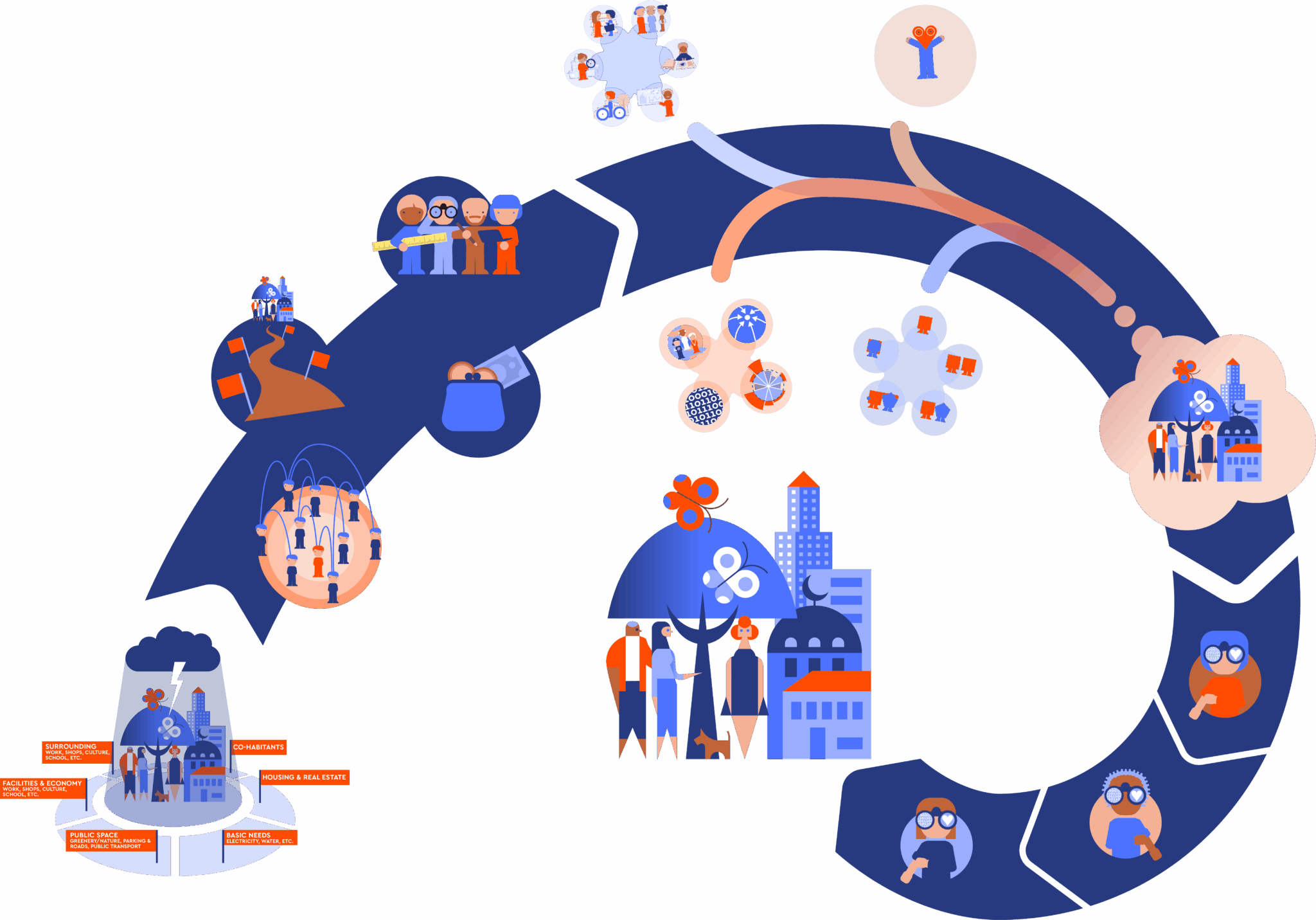
The illustration above shows the steps of the roadmap. Each of these steps helps to prevent fragmentation, administrative delays, and paper reality. And more importantly, to build a resilient neighborhood that genuinely contributes to the quality of life of its residents. A neighborhood that can take a beating—in ten years and in 30 years.
Here is a preview of the methodology:
Forge a neighborhood coalition
Who feels the pain most when things go wrong? And who has the most to gain when things improve? These parties form a neighborhood coalition that ‘carries’ the renewal. The municipality and residents are always involved. Add leadership, a steering team, a start-up budget, and a clear process rhythm, and you have the foundation.
Get to know the neighborhood
No assumptions, no fixed mindset, no models tailored to ‘the average neighborhood’. Look, listen, immerse yourself in the DNA of the place, from a position of appreciation. Use a kaleidoscopic approach, from data-driven analyses to conversations in the laundromat. What are the qualities, strengths, opportunities, and vulnerabilities? That is your starting point.
How do societal transitions affect the neighborhood?
The neighborhood does not exist in a vacuum. So: how do social transitions -shifts in social order, globalization, digitization, and sustainability- affect this place? How can the neighborhood best respond to these changes in the future? Without a crystal ball, but with strategic awareness.
Consciously examine your values
This neighborhood coalition, which images, beliefs, and dogmas does it hold? And what happens when they become aware of these? Put the most inspired dreams about how the neighborhood could possibly develop alongside these. And arrive at a transparent choice of underlying values. This will give your future story clarity.
Build resilience
Resilience is almost a physical design principle. It requires attention to all aspects: robustness, a certain surplus, diversity, interconnectedness, and learning ability/flexibility. This allows you to deliberately forge future-proofing into the story.
The art of creating a single narrative from many perspectives
The biggest challenge? Determining a single, integrated course. Specialists must set aside their pet projects. And some choices will be painful. But the integrated experience of the residents comes first. Because a good bus connection is nice, but useless if residents cannot afford the ticket.
Focus on implementation – in five-year cycles
From vision to action. No master plans without implementation, but concrete five-year plans. Small enough to remain feasible. Large enough to stay on course. Test the monitored interim results along the way against the core values of the future story. And adjust where necessary, without losing direction.
This roadmap has emerged from practice and study. And from a love for neighborhoods that deserve more than just ‘doing our best’. Based on the slow-cooking principle. Because with structured steps, open attention, the craftsmanship of collaborating specialists, and leadership, the neighborhood becomes more ‘nourishing’ for its residents.
This methodology requires further research and dialogue. So, let’s talk.
In-depth publications on all aspects of this roadmap will appear step by step on this website, followed by a number of neighborhood renewal cases (Almere, Mumbai, Tangier) set against the roadmap.